
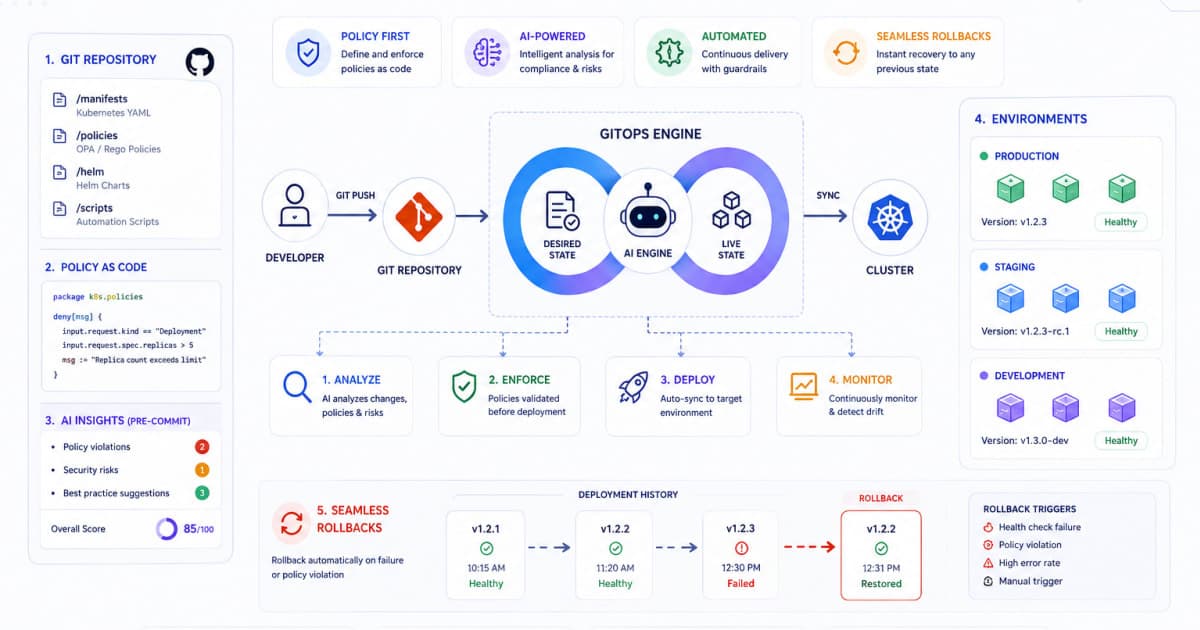
Introduction to AI‑Driven GitOps
The pace at which modern applications evolve has made continuous delivery a necessity rather than a luxury. GitOps has emerged as a declarative approach that treats Git repositories as the single source of truth for all infrastructure and application deployments. However, as teams scale and the number of environments grows, maintaining consistent policies and managing rollbacks becomes increasingly complex.
Enter AI‑Driven GitOps: the fusion of machine‑learning models with GitOps workflows to automatically enforce policies, predict failures, and orchestrate intelligent rollbacks. By leveraging data from CI/CD pipelines, runtime metrics, and security scanners, AI can surface anomalies, recommend remediation steps, and even execute rollback actions without human intervention.
In this article we will explore the foundations of GitOps, the challenges of policy enforcement, how AI can enhance governance, design principles for an AI‑powered policy engine, and real‑world examples that showcase the power of this emerging paradigm.
GitOps Foundations and Policy Challenges
What Is GitOps?
Declarative configuration stored in Git
Automated reconciliation: a controller continuously applies the desired state
Immutable infrastructure: changes are only made via pull requests
Auditability: every change is version‑controlled and traceable
Popular tools Flux, Argo CD, and Spinnaker implement these principles, but they largely rely on static rules defined by operators.
Common Policy Challenges
Compliance drift: manual policy updates can lag behind code changes
Security misconfigurations: subtle errors in YAML files slip through code reviews
Rollback latency: manual rollbacks are time‑consuming and error‑prone
Multi‑environment parity: ensuring identical policies across dev, staging, and prod
These challenges increase the risk of outages, security breaches, and regulatory non‑compliance.
How AI Enhances Policy Enforcement
AI augments GitOps by providing context‑aware decision making. Key ways include:
Anomaly detection: ML models analyze historical deployment data to flag out‑of‑norm changes
Policy inference: NLP models parse comments, issue titles, and PR descriptions to infer intent and auto‑apply relevant policies
Risk scoring: Bayesian models compute a risk metric for each change, enabling triage prioritization
Automated remediation: Reinforcement learning agents learn the optimal rollback or patch sequence based on past outcomes
Tip: Start with a supervised learning approach for anomaly detection; it is easier to interpret and debug than deep reinforcement learning.
Example: AI‑Assisted Code Review
When a pull request is opened, an AI model can scan the diff and suggest policy violations. This is similar to how AI-Powered Code Review Tools: Boost Code Quality scan for style and security issues, but here the focus is on infrastructure and deployment policies.
# Example policy definition in a GitOps repo
apiVersion: policy.openpolicyagent.org/v1
kind: Policy
metadata:
  name: restrict-privileged-containers
spec:
  rules:
    - name: no-root
      match:
        resources:
          - kind: Deployment
      validate:
        message: "Containers must not run as root"
        condition: "not (root: true)"
An AI assistant can automatically flag a PR that introduces a securityContext: runAsUser: 0 line and suggest adding the no-root rule.
Designing an AI‑Powered Policy Engine
Core Components
Data Ingestion Layer
Pulls events from Git, CI/CD, monitoring, and security scanners
Normalizes data into a unified schema
Feature Extraction Module
Transforms raw logs, diffs, and metrics into features
Uses embeddings for textual data (PR titles, comments)
Inference Engine
Hosts ML models (classification, regression, reinforcement learning)
Returns risk scores, suggested actions, or policy updates
Policy Store
Version‑controlled repository of OPA (Open Policy Agent) policies or Kubernetes Custom Resources
Supports dynamic updates via AI recommendations
Execution Layer
Triggers reconciliation controllers or rollback scripts
Logs decisions for auditability
Model Selection
TaskModel TypeRationaleAnomaly detectionIsolation ForestHandles high‑dimensional data, interpretableIntent inferenceBERT fine‑tuned on PR dataCaptures semantic meaning in natural languageRollback optimizationQ‑learningLearns best sequence of actions from past rollbacks
> Tip : Use explainable AI (XAI) techniques to surface why a policy was flagged; this builds trust with operators.
Integration with Existing Toolchains
Git Hooks: Trigger AI inference on push or PR events
Webhooks: Feed data into the ingestion layer
Custom Controllers: Extend Flux or Argo CD with AI decision hooks
Dashboard: Visualize risk scores and AI recommendations
Automated Rollback Strategies Powered by AI
Rollback is more than a simple revert; it’s a decision problem that balances service availability, data integrity, and cost. AI can streamline this process:
Predictive Rollback
Models forecast the likelihood of failure based on recent metrics (latency spikes, error rates)
If probability exceeds a threshold, a rollback is automatically queued
Rollback Sequencing
Reinforcement learning agents learn the optimal order of rolling back services to minimize downtime
For example, rolling back a database schema change before the application layer
Hybrid Human‑AI Rollback
AI proposes a rollback plan, operators approve or tweak it
The plan is then executed via CI/CD pipelines
Code Example: AI‑Driven Rollback Trigger
# Hook that runs after a deployment
if ai_predict_failure > 0.8; then
  echo "High failure risk detected. Initiating rollback."
  git checkout $PREVIOUS_COMMIT
  flux sync
fi
Tip: Store rollback history in a dedicated Git branch; this provides an auditable trail of what was rolled back and why.
Integrating AI into Existing GitOps Toolchains
ToolIntegration PointAI FunctionFluxGitHub webhookAnomaly detection on new manifestsArgo CDPre‑sync hookPolicy inference and risk scoringJenkinsPost‑build stepPredictive rollback triggersPrometheusAlertmanagerAI‑based anomaly alerts
Step‑by‑Step Integration
Set up a central AI service (could be a serverless function or a Kubernetes pod).
Configure webhooks from Git and CI/CD to send events to the AI service.
Return decisions via a REST API; the receiving tool applies the recommendation.
Persist decisions in a GitOps policy branch for future reference.
Real‑World Case Studies
1. Global FinTech Company
Challenge: Frequent policy violations in Kubernetes manifests led to security incidents.
Solution: Deployed an AI model that parsed PR diffs, identified potential violations, and auto‑applied OPA policies.
Outcome: 60 % reduction in manual policy reviews and zero security incidents over six months.
2. SaaS Provider with Multi‑Tenant Architecture
Challenge: Rolling back a buggy deployment across 50 tenants without impacting live traffic.
Solution: Reinforcement learning agent suggested a staged rollback first to a subset of tenants, then to the rest based on historical latency data.
Outcome: Downtime reduced from 45 minutes to 10 minutes.
3. Open‑Source Project
Challenge: Maintaining consistent policies across a rapidly evolving repo.
Solution: AI‑powered policy engine automatically merged policy updates from community PRs after verifying compliance.
Outcome: Policy drift eliminated; contributors could focus on feature work.
Best Practices and Common Pitfalls
Best Practices
Start Small: Pilot AI on a single policy domain before scaling.
Explainability: Provide operators with clear explanations for AI decisions.
Version Control: Store AI models and configurations in Git for reproducibility.
Continuous Retraining: Periodically update models with fresh data to avoid concept drift.
Security Hardening: Secure the AI service itself; it becomes a critical control point.
Common Pitfalls
Over‑automation: Blindly trusting AI can lead to cascading failures.
Data Silos: Ignoring telemetry from monitoring tools limits AI effectiveness.
Model Bias: Training data that lacks diversity can produce unfair policy enforcement.
Neglecting Human Oversight: Operators may become complacent if AI makes all decisions.
Tip: Adopt a “human‑in‑the‑loop” policy for critical actions, especially rollbacks affecting production data.
Future Trends in AI‑Driven GitOps
Zero‑Trust Policy Enforcement
AI will continuously validate that every deployment adheres to least‑privilege principles.
Self‑Healing Infrastructure
Models will not only rollback but also autonomously patch vulnerabilities and re‑configure resources.
Federated Learning Across Organizations
Teams can share anonymized policy data to improve models without compromising proprietary information.
AI‑Assisted Compliance Reporting
Automated generation of audit logs and compliance dashboards.
Quantum‑Resistant Policy Checks
As quantum threats loom, AI models will incorporate post‑quantum cryptographic checks into GitOps pipelines.
Conclusion
AI‑Driven GitOps represents a powerful synergy between declarative deployment practices and intelligent automation. By embedding machine‑learning models into policy enforcement and rollback mechanisms, organizations can achieve higher reliability, tighter security, and faster time‑to‑market. While challenges remain particularly around trust, explainability, and governance the trajectory of this technology points toward fully autonomous, self‑healing delivery pipelines.
Next steps for teams looking to adopt AI‑Driven GitOps:
Audit your current GitOps stack for integration points.
Identify high‑impact policy domains for pilot projects.
Build or adopt an AI inference service with explainability features.
Iterate, monitor, and retrain to maintain model relevance.
FAQs
1. How does AI‑Driven GitOps differ from traditional CI/CD automation?
Traditional CI/CD focuses on code build and deployment, while AI‑Driven GitOps adds a layer of predictive governance automatically enforcing policies, detecting anomalies, and orchestrating intelligent rollbacks based on data patterns.
2. Is it safe to let AI decide when to rollback production services?
Yes, if the AI system is built with robust risk scoring, explainability, and human‑in‑the‑loop checks. Many organizations adopt staged rollbacks and require operator approval for critical environments.
3. What data sources are needed to train effective AI models for policy enforcement?
Git events (commits, PRs), CI/CD logs, runtime metrics (latency, error rates), security scan results, and configuration files. The richer the dataset, the more accurate the predictions.
4. Can AI‑Driven GitOps help with regulatory compliance?
Absolutely. AI can automatically enforce compliance rules encoded as policies, detect deviations, and generate audit‑ready reports, reducing manual effort in compliance checks.
5. Are there open‑source tools available to start building an AI‑powered policy engine?
Yes projects like OPA, Kube‑Guard, and Argo Rollouts can be extended with custom AI plugins. Additionally, frameworks like TensorFlow Serving

