Introduction
In today’s fast‑paced software ecosystem, maintaining a high level of code quality is no longer a luxury it’s a necessity. Traditional code reviews, while invaluable, can become bottlenecks as teams scale. Enter AI‑powered code review tools: systems that blend machine learning with static analysis to provide real‑time, actionable feedback. This article delves into how these tools transform the review process, the benefits they bring, and how teams can harness them effectively.
Why Code Review Still Matters
Even with automated checks, human insight remains crucial. Code reviews:
Catch subtle logic errors that static analyzers may miss.
Enforce architectural consistency across a codebase.
Facilitate knowledge transfer among developers.
Cultivate a culture of quality and shared ownership.
The challenge is scaling these benefits without overburdening reviewers. AI can help by handling routine checks, freeing humans to focus on higher‑level concerns.
Evolution of Code Review: From Manual to Automated
EraTypical PracticesLimitations1990sPeer‑to‑peer reviews, printed diffsTime‑consuming, inconsistent standards2000sTool‑assisted diff viewers, checklistsStill manual, high cognitive load2010sStatic analysis, linters, CI pipelinesRules are rule‑based, lack context2020sAI‑powered assistants, semantic analysisEmerging, but promising integration
The shift from manual to automated has been incremental, each wave addressing specific pain points. AI represents the next leap by adding intelligence and adaptability.
How AI‑Powered Code Review Works
AI code review engines typically perform the following steps:
Feature Extraction – Convert source files into embeddings that capture syntax, semantics, and context.
Model Inference – Apply a trained model (e.g., transformer, graph neural network) to predict potential defects or style violations.
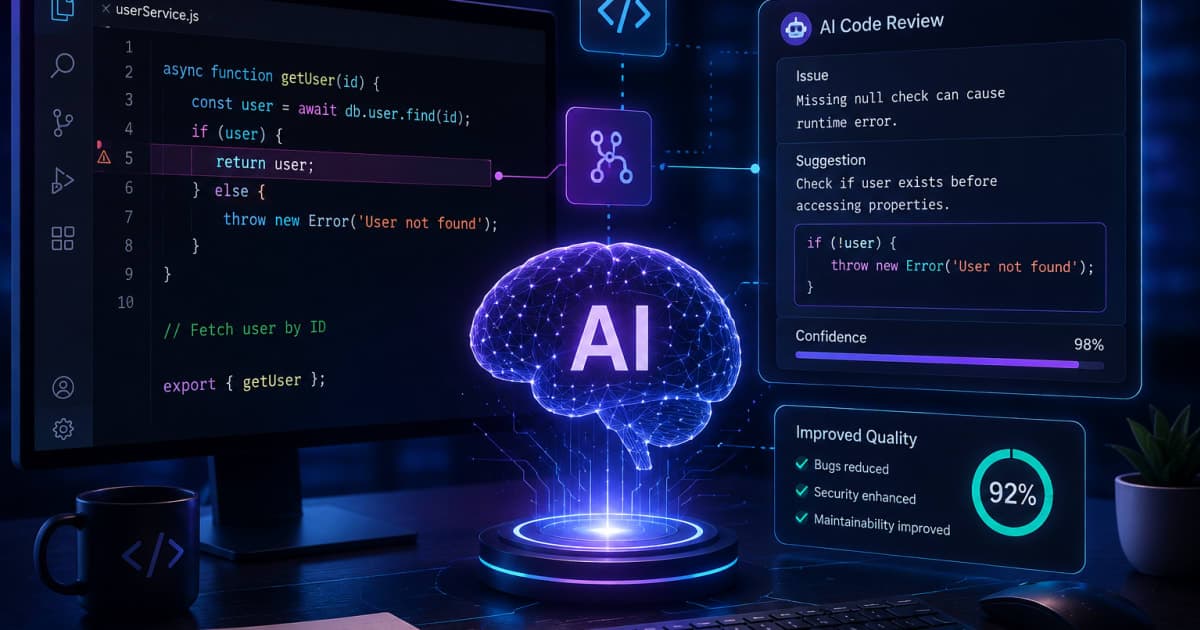
Explainability Layer – Generate human‑readable explanations or code snippets highlighting the issue.
Feedback Loop – Collect reviewer corrections to continuously refine the model.
Example: An AI model might flag a method that mutates a global state without proper synchronization, citing similar patterns from a large corpus of proven concurrent code.
Code Example: A Simple Linter Rule
# Traditional rule: no variable named 'tmp'
for line in file:
    if 'tmp' in line:
        report_issue(line_number, "Avoid using 'tmp' as a variable name")
AI‑Enhanced Version
# The model predicts risk based on context
for line, context in enumerate(file):
    risk = model.predict(context, token='tmp')
    if risk > 0.8:
        explanation = model.explain(context, token='tmp')
        report_issue(line, explanation)
The AI version not only flags the issue but also provides a context‑aware explanation.
Top AI‑Driven Code Review Tools
1. CodeGuru Reviewer
Provider: Amazon Web Services
Strengths: Deep integration with AWS, supports Java and Python, offers actionable recommendations.
Key Features: Code metrics, security vulnerability detection, automated review comments.
2. DeepCode (now part of Snyk)
Provider: Snyk
Strengths: Open‑source focus, extensive language support.
Key Features: Historical code analysis, pattern matching across millions of commits.
3. SonarQube AI Extension
Provider: SonarSource
Strengths: Extends the well‑known SonarQube platform with ML models.
Key Features: Custom rule creation, anomaly detection.
4. GitHub Copilot Labs – Review Mode
Provider: GitHub
Strengths: Seamless GitHub integration, real‑time suggestions.
Key Features: Pull request commentary, quick fix generation.
5. Codota AI Review
Provider: Codota (now part of Tabnine)
Strengths: Language‑agnostic, large training corpus.
Key Features: Code completion, review comments, refactoring suggestions.
Key Benefits for Development Teams
BenefitDescriptionReduced Review TimeAI surfaces the most critical issues, allowing reviewers to focus on complex logic.Consistent QualityModels enforce coding standards uniformly across teams.Early Defect DetectionPredictive analytics catch bugs before they reach CI.Knowledge SharingAI explanations serve as learning material for junior developers.ScalabilityHandles thousands of pull requests without additional human resources.
Case Study: A fintech firm reported a 35% drop in post‑release bugs after integrating an AI reviewer, while review turnaround improved from 3 days to under 12 hours.
Challenges and Limitations
Model Bias – Training data may over‑represent certain coding patterns, leading to false positives.
Explainability Gap – Some models produce opaque suggestions, making it hard for developers to trust them.
Integration Overhead – Setting up pipelines can be complex, especially in legacy environments.
Security Concerns – Models may inadvertently expose sensitive code snippets during inference.
Maintenance Burden – Models require continuous retraining to stay relevant with evolving codebases.
Best Practices for Integrating AI Reviews
Start Small – Deploy the AI tool on a subset of repositories to gauge accuracy.
Human‑in‑the‑Loop – Keep reviewers in control; use AI as an assistant, not a replacement.
Define Clear Acceptance Criteria – Specify thresholds for model confidence before auto‑merging.
Collect Feedback – Use reviewer votes to retrain the model iteratively.
Monitor Metrics – Track false‑positive rates, review time, and defect density to measure ROI.
Secure the Pipeline – Ensure that the AI service runs in a sandboxed environment with strict access controls.
Future Trends in AI‑Assisted Development
Multimodal Analysis – Combining code, documentation, and issue trackers for richer context.
Zero‑Shot Code Generation – AI suggesting complete refactorings based on high‑level intent.
Explain‑able AI (XAI) – Models that provide natural‑language rationales for every suggestion.
Continuous Learning – Systems that adapt in real time to new coding patterns without retraining.
Cross‑Language Transfer – Leveraging knowledge learned in one language to improve reviews in another.
Vision: Imagine a review system that not only points out a bug but also offers a one‑click migration path to a safer API, all while learning from the team's own code history.
Conclusion
AI‑powered code review tools are reshaping how teams approach quality assurance. By automating routine checks and augmenting human judgment, they deliver faster, more consistent reviews and foster a culture of continuous improvement. While challenges remain particularly around bias, explainability, and integration careful adoption and iterative refinement can unlock significant productivity gains. As the technology matures, we can expect deeper integration with development workflows, more sophisticated contextual understanding, and ultimately, codebases that are not just functional but also inherently safer and more maintainable.