
Introduction
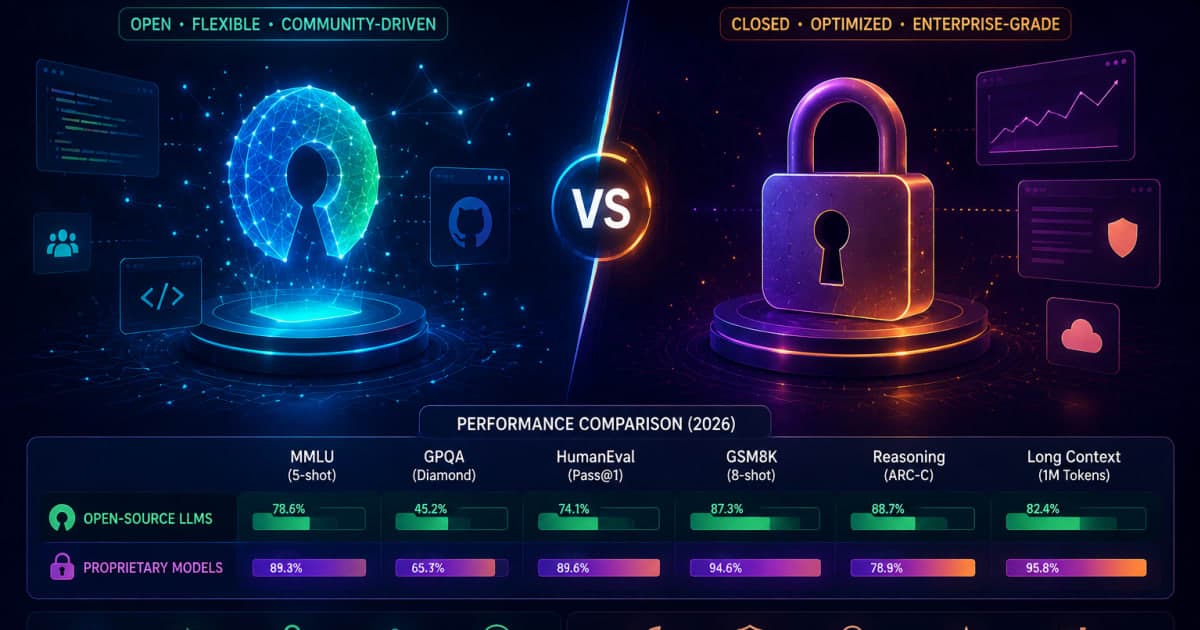
Large Language Models (LLMs) have become the cornerstone of modern AI applications, from conversational agents to code generation tools. By 2026, the ecosystem is split between open‑source LLMs that anyone can download, modify, and deploy, and proprietary models that are accessed via APIs or bundled with hardware. This article explores how these two worlds compare in terms of performance, licensing, and business impact, and looks ahead to the convergence and divergence trends that will shape the industry.
Performance Landscape in 2026
Open‑Source LLMs
The open‑source community has accelerated the release of several high‑performance models:
LLaMA 3 (Meta) – 70 B and 280 B variants with a 4‑bit quantized version that runs on consumer GPUs.
Phi‑3 (Microsoft) – 4 B and 13 B weights optimized for edge inference.
Mistral 7B (Mistral) – lightweight yet competitive on instruction‑following benchmarks.
StableLM (Stability AI) – a family of models ranging from 7 B to 13 B with a focus on safety.
These models achieve competitive results on standard benchmarks while offering the flexibility to fine‑tune on proprietary data.
Proprietary Models
Commercial vendors continue to push the envelope with models that combine massive scale with specialized training:
GPT‑4o (OpenAI) – 1 trillion‑parameter model with multimodal capabilities and fine‑tuned alignment.
Claude 3 (Anthropic) – 200 B parameters with a safety‑first design.
Gemini Pro (Google) – 500 B parameters, integrated with Google Cloud’s TPU‑v4 infrastructure.
Azure OpenAI Service – offers custom‑tuned variants of GPT‑4 for enterprise workloads.
These models are typically accessed through APIs, offering pay‑per‑use pricing and built‑in compliance features.
Comparative Metrics
Metric | Open‑Source | Proprietary |
|---|---|---|
Parameter Count | 4 B–280 B | 200 B–1 T |
Inference Latency (GPU) | 30 ms (4‑bit) – 200 ms (FP16) | 10 ms (TPU‑v4) – 50 ms (GPU) |
Throughput (Tokens/s) | 5 k – 15 k | 20 k – 40 k |
Energy Consumption | 0.5 kWh/1 M tokens | 0.3 kWh/1 M tokens |
Cost per 1 M tokens | $0.50 – $2.00 (self‑hosted) | $0.01 – $0.05 (API) |
While proprietary models still outpace open‑source in raw speed and scale, the gap is narrowing thanks to advances in quantization, model pruning, and efficient transformer architectures.
Benchmark Methodologies and Evaluation Criteria
Standard Benchmarks
MMLU (Massive Multitask Language Understanding) – tests general knowledge across 57 subjects.
GPT‑4 Eval – a curated set of tasks that gauge reasoning, math, and coding.
Winograd Schema Challenge – evaluates coreference resolution.
ARC (AI‑Research Challenge) – tests scientific reasoning.
These benchmarks are run on a benchmark‑as‑a‑service platform that standardizes hardware (e.g., A100 GPUs, TPU‑v4) and evaluation scripts.
Evaluation Criteria
Criterion | Why It Matters | Measurement |
|---|---|---|
Accuracy | Determines model usefulness | % correct on benchmark |
Latency | Affects user experience | ms per inference |
Throughput | Determines capacity | tokens per second |
Energy Efficiency | Cost and sustainability | kWh per token |
Robustness | Handles edge cases | failure rate on adversarial prompts |
Fairness & Bias | Regulatory compliance | bias metrics across demographics |
Methodology
Hardware Standardization – All tests run on the same GPU/TPU cluster to eliminate hardware bias.
Reproducibility – Open‑source evaluation scripts are stored in GitHub repositories and pinned to specific commits.
Statistical Significance – Each benchmark is repeated 10 times; confidence intervals are reported.
Real‑World Workloads – In addition to synthetic benchmarks, industry use‑cases (e.g., code synthesis, customer support) are included.
Tip: For developers wanting to run their own benchmarks, the [How to Format JSON Online Complete Guide] provides a quick way to serialize test results.
Licensing Trends and Legal Considerations
Open‑Source Licenses
License | Key Provisions | Typical Use‑Case |
|---|---|---|
Apache 2.0 | Permissive, patent grant | Enterprise deployments |
MIT | Very permissive, minimal restrictions | Rapid prototyping |
Creative Commons BY‑NC | Attribution, non‑commercial | Research projects |
Custom Dual‑License | Open‑source core + commercial add‑ons | Vendor‑specific features |
Open‑source LLMs usually come with model weight licenses that allow redistribution but restrict commercial use of the trained weights. However, many projects now offer dual‑licensing: the base model under a permissive license, while fine‑tuned checkpoints are licensed for commercial use only.
Proprietary Licenses
Subscription APIs – pay‑per‑token, with SLA guarantees.
Enterprise Contracts – on‑prem deployment, data residency clauses.
Model‑as‑a‑Service – includes usage limits, compliance audits.
Proprietary vendors often provide data‑processing agreements that ensure user data does not get used to retrain the base model, addressing privacy concerns.
Legal Considerations
Data Privacy – GDPR, CCPA, and India’s PDPB require explicit user consent for data ingestion.
Model Copyright – In some jurisdictions, the training data may be copyrighted, impacting the legality of the generated content.
Export Controls – Certain LLMs are subject to ITAR or EAR restrictions if they are used for defense or intelligence applications.
Prompt‑Injection Attacks – Legal liability may arise if a model is manipulated to produce disallowed content.
Note: When integrating LLMs into a product, consult your legal team to draft Terms of Service that cover content liability and data usage.
Business Implications and Adoption Strategies
Cost‑Benefit Analysis
Factor | Open‑Source | Proprietary |
|---|---|---|
Initial Investment | Hardware, DevOps | API fees |
Operational Overhead | Model maintenance, scaling | Vendor support |
Scalability | Limited by on‑prem resources | Elastic cloud |
Compliance | In‑house control | Vendor‑managed |
A typical cost‑benefit matrix shows that for high‑volume workloads, proprietary APIs can be cheaper when factoring in infrastructure and maintenance. For low‑volume or high‑security scenarios, self‑hosting an open‑source model may be more economical.
Integration Strategies
Hybrid Deployment – Run the model locally for sensitive data, and use the API for general queries.
Fine‑Tuning Pipelines – Use open‑source frameworks (e.g., Hugging Face 🤗) to adapt a base model to domain data.
Edge Inference – Deploy quantized models (4‑bit, 8‑bit) on mobile or IoT devices.
Compliance Gateways – Build a wrapper that logs all prompts and outputs for auditability.
Case Studies
FinTech – A payment‑gateway provider used LLaMA 3 fine‑tuned on transaction logs to detect fraud, reducing false positives by 12 % while keeping data on‑prem.
Healthcare – A hospital system integrated GPT‑4o for clinical documentation, leveraging OpenAI’s data‑processing agreement to maintain HIPAA compliance.
E‑Commerce – A retailer deployed Claude 3 via Azure to power personalized product recommendations, achieving a 3 % lift in conversion rates.
Pro Tip: For developers looking to showcase their contributions to open‑source LLMs, the [How to Build an Impressive GitHub Profile README (2026)] article offers actionable tips on documentation and visibility.
Vendor Selection Checklist
Model Size & Accuracy – Does it meet your domain requirements?
Latency SLA – Is the response time acceptable for your use‑case?
Data Residency – Can the vendor host data in your required jurisdiction?
License Flexibility – Are you comfortable with the licensing terms?
Support & Updates – How frequently does the vendor release patches?
Future Outlook: Convergence and Divergence
Convergence Trends
Open‑Weight Sharing – Several vendors are releasing pre‑trained checkpoints under permissive licenses to foster ecosystem growth.
Federated Learning – Collaborative training across multiple organizations without centralizing data.
Hardware‑Software Co‑Design – AI‑optimized chipsets (e.g., [AI‑Optimized Chipsets 2026: Insights for Developers] ) are lowering inference costs and enabling larger models on edge devices.
Divergence Trends
Domain‑Specific Proprietary Models – Companies like DeepMind and NVIDIA are building niche models (e.g., protein folding, autonomous driving) that are not open‑source due to strategic reasons.
Regulatory Divergence – Different countries are adopting varying standards for model auditability, leading to fragmented compliance requirements.
Economic Barriers – The cost of training trillion‑parameter models remains prohibitive, maintaining a divide between large enterprises and smaller players.
What This Means for 2027 and Beyond
Hybrid Ecosystem – Expect a mix of open‑source cores with proprietary fine‑tuning layers.
Standardization of Benchmarks – Industry bodies may formalize benchmark suites to ensure fair comparison.
Ethical Governance – Increased emphasis on explainability and bias mitigation will shape licensing clauses.
Conclusion
By 2026, the LLM landscape has matured into a nuanced ecosystem where open‑source and proprietary models coexist, each offering distinct advantages. Open‑source models provide transparency, customization, and cost control, making them ideal for privacy‑sensitive or highly specialized applications. Proprietary models, backed by robust APIs and compliance frameworks, excel in scalability and rapid deployment for high‑volume