Introduction
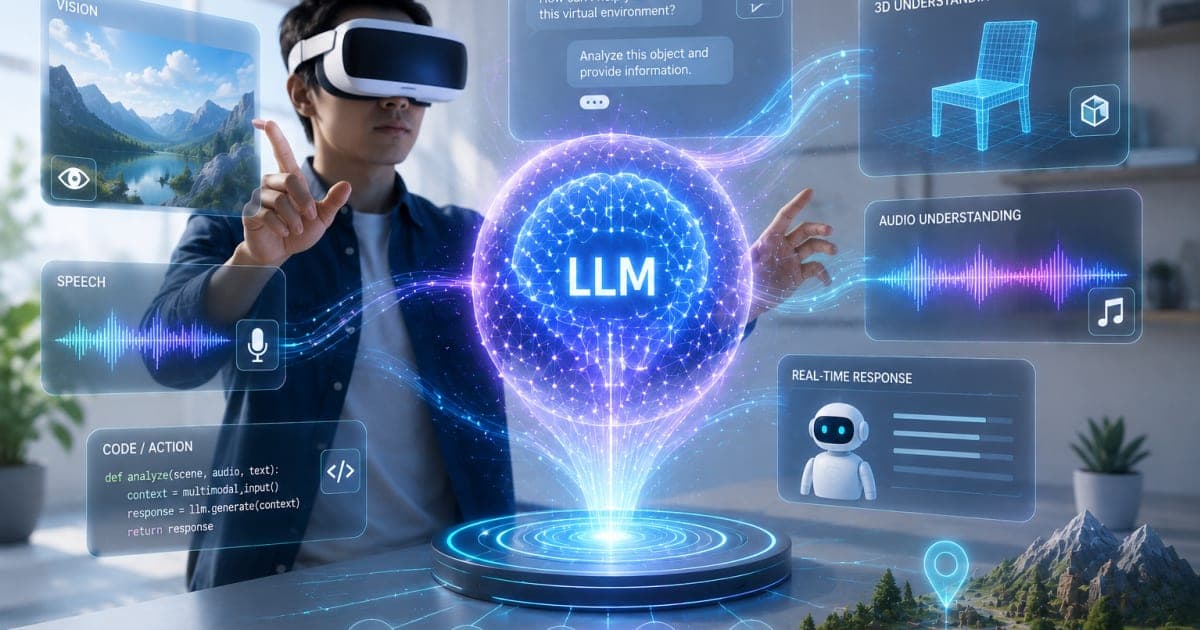
Virtual Reality (VR) and Augmented Reality (AR) are no longer niche playgrounds for game developers; they are becoming mainstream platforms for education, training, marketing, and remote collaboration. The next leap forward is the fusion of real‑time multimodal large language models (LLMs) with these immersive environments. By feeding a VR/AR application with a model that understands text, vision, audio, and even motion, designers can build experiences that adapt on the fly, respond to user intent, and generate content dynamically.
This article dives deep into the practical aspects of embedding multimodal LLMs into VR/AR pipelines. We’ll cover the core concepts, architectural patterns, data fusion strategies, performance tricks, and the ethical considerations that every Indian tech professional should know before launching a project. Whether you’re a product manager, a Unity developer, or a backend engineer, this guide will give you the roadmap to turn a static virtual scene into an intelligent, conversational, and interactive world.
What Are Multimodal LLMs?
Multimodal LLMs are neural models trained to process multiple data modalities text, images, audio, and sometimes even sensor streams simultaneously. Unlike classic language‑only models, these systems can, for example, answer a spoken question about a 3‑D object, generate a short narration for a virtual tour, or suggest visual edits based on textual prompts.
Key characteristics:
Shared representation space: Text, vision, and audio embeddings are projected into a common latent space, enabling cross‑modal retrieval and generation.
Conditional generation: The model can produce new content conditioned on a mix of modalities, such as generating a dialogue script that references a current scene.
Fine‑tuning flexibility: You can specialize a base multimodal LLM on domain‑specific data (e.g., medical imaging, architectural blueprints) without re‑training from scratch.
For developers, the exciting part is that these models can now run in edge‑friendly configurations, allowing them to serve VR/AR apps on consumer hardware or low‑latency cloud setups.
Tip: When choosing a multimodal LLM, look for models that expose a lightweight inference API, such as OpenAI’s
gpt-4o-minior Meta’sLlama 3.2-vision. These variants are optimized for latency and memory footprint.
Real‑Time Constraints in VR/AR
A VR/AR experience demands sub‑16 ms per frame to avoid motion sickness and preserve immersion. Adding a language model introduces latency that can quickly exceed this budget. Key constraints to consider:
Compute budget: Mobile GPUs, HoloLens, or ARKit devices have limited processing power.
Network latency: Cloud inference adds round‑trip delays; even 50 ms can break the illusion.
Synchronization: Audio‑visual alignment must remain tight; lagging dialogue can feel disjointed.
To meet these constraints, you typically split the pipeline:
Local preprocessing: Capture sensor data, perform lightweight feature extraction on-device.
Edge or cloud inference: Run the LLM on a server or on‑device accelerator.
Post‑processing: Convert the model’s output into actionable commands for the rendering engine.
By keeping the heavy lifting off‑device but still within a few milliseconds, you preserve frame rates while still leveraging the power of multimodal reasoning.
System Architecture for Integration
Below is a high‑level architecture that balances performance and flexibility. It can be adapted for Unity, Unreal, or web‑based XR frameworks.
+--------------------+          +-------------------+          +------------------+
|  XR Client (Unity) | <--->    |  Edge Inference   | <--->    |  Cloud LLM API   |
+--------------------+          +-------------------+          +------------------+
        |                           |                               |
        | 1. Capture frame/audio    |                               |
        | 2. Encode modalities      | 3. Send request              |
        | 3. Receive response       | 4. Decode response           |
        | 4. Execute commands       |                               |
        +---------------------------+-------------------------------+
1. XR Client
Sensor integration: Use Unity’s
XRInputSubsystemto gather positional data, hand tracking, and environmental mapping.Local inference: For latency‑critical tasks (e.g., gesture recognition), run a lightweight transformer on the device using ONNX Runtime.
2. Edge Inference Layer
Hardware: A small GPU or TPU (e.g., NVIDIA Jetson Nano) that can handle the multimodal model in real time.
API Gateway: Expose a REST or gRPC endpoint that accepts encoded frames, audio snippets, and textual prompts.
3. Cloud LLM API
Scaling: Deploy the multimodal LLM on a GPU cluster with autoscaling.
Caching: Store recent queries to reduce repeated inference for static scenes.
Security: Enforce TLS and token‑based authentication.
Tip: Use a content‑delivery network (CDN) to place edge servers closer to your user base, cutting down on round‑trip times.
Data Pipelines and Modal Fusion
1. Encoding Modalities
ModalityEncoderOutput FormatImageVision Transformer512‑dim vectorAudioWaveNet or Wav2Vec256‑dim vectorTextBPE tokenizer768‑dim vectorMotionPoseNet or 3‑D joint encoder128‑dim vector
> **Tip**: Batch encode multiple frames (e.g., a 2‑second window) to amortize CPU overhead.
2. Fusion Strategies
Early Fusion: Concatenate raw embeddings before feeding them to the LLM. Works well when modalities are tightly coupled.
Late Fusion: Run separate sub‑models and merge predictions at the output layer. Useful when modalities are independent.
Cross‑Attention: Let the LLM attend across modalities dynamically. This is the most flexible but computationally heavier.
3. Streaming Pipelines
For continuous interaction, stream audio and video frames to the server using WebRTC or QUIC. Keep a sliding window of recent data to provide context to the LLM without sending the entire history.
Designing Interactive Experiences
1. Contextual Dialogue
A multimodal LLM can maintain a dialogue state that references the current scene. Example:
User: "Show me the ancient temple again."
LLM: "Sure, here’s a 3‑D reconstruction of the temple.  Let’s focus on the carvings on the left wall."
The LLM outputs a command payload:
{
  "action": "load_scene",
  "scene_id": "temple_v1",
  "focus_point": { "x": 12, "y": 3, "z": -8 }
}
2. Dynamic Content Generation
Procedural narration: Generate a story that adapts to user choices.
Real‑time translation: Translate spoken language into subtitles or audio in a different language.
Adaptive difficulty: Adjust puzzle complexity based on user performance metrics.
3. User‑Generated Prompts
Allow users to type or speak commands like “Add a holographic map of the area” or “Translate the sign in Hindi.” The LLM interprets, validates, and translates the request into engine actions.
Performance Optimization
TechniqueDescriptionBenefitModel quantization16‑bit or 8‑bit weightsReduces memory, speeds inferenceKnowledge distillationTrain a smaller student modelMaintains accuracy with lower costAsynchronous pipelinesDecouple rendering from inferenceKeeps frame rate stableEarly exitStop inference when confidence is highSaves computeCachingStore recent scene embeddingsAvoids redundant encoding
> **Tip**: Profile your pipeline with Unity’s Profiler and NVIDIA Nsight to pinpoint bottlenecks. Focus on the **GPU kernel launch time** and **memory bandwidth**.
Security, Privacy, and Ethics
1. Data Protection
Encryption: Use TLS 1.3 for all data in transit.
Anonymization: Strip personally identifiable information from audio/text before sending to the LLM.
Local storage: Keep sensitive logs on the device and delete them after use.
2. Consent and Transparency
Inform users when their speech or gestures are being analyzed.
Provide an opt‑out mechanism for data collection.
3. Bias Mitigation
Multimodal LLMs can propagate biases present in training data. Mitigate by:
Using domain‑specific fine‑tuning with curated datasets.
Implementing a content filter that flags or blocks inappropriate outputs.
4. Regulatory Compliance
For Indian users, align with the Digital Personal Data Protection Bill (draft) and the Information Technology (Reasonable Security Practices and Procedures and Sensitive Personal Data or Information) Rules.
Reference the article on The Impact of New AI Regulation Bills on Tech Companies for deeper insights.
Case Studies and Real‑World Implementations
1. Heritage Conservation VR
A museum in Jaipur used a multimodal LLM to generate guided tours in multiple languages. The system captured user gestures to switch between different historical periods, providing contextual narration in real time.
2. Industrial Training AR
An automotive plant deployed an AR overlay that identified faulty parts by analyzing the visual feed and spoken queries. The LLM suggested repair steps and updated the 3‑D model on the fly.
3. Remote Collaboration Platform
A startup built a shared VR workspace where participants could ask the system to “summarize the last 10 minutes of discussion” or “visualize the data in a 3‑D heat map.” The multimodal LLM combined speech, hand gestures, and screen captures to produce actionable insights.
Future Trends and Emerging Technologies
Edge‑AI chips: Upcoming NVIDIA Grace Hopper and Apple’s M2 Ultra promise on‑device inference at 30 fps for large multimodal models.
NeRF‑based rendering: Neural Radiance Fields can generate photorealistic scenes from sparse inputs, which can be paired with LLMs to create dynamic environments.
Federated learning: Train multimodal models across devices without centralizing data, enhancing privacy.
Cross‑modal retrieval: Use LLMs to map user queries directly to 3‑D assets, reducing the need for manual tagging.
Tip: Keep an eye on the evolving standards in the XR industry, such as the OpenXR 1.2 specification, which now includes extensions for multimodal input handling.
Conclusion
Integrating real‑time multimodal large language models into VR/AR experiences is no longer a futuristic dream it is an actionable strategy that can elevate user engagement, streamline content creation, and unlock new business models. By carefully architecting the system, optimizing pipelines, and addressing security and ethical concerns, Indian tech teams can build immersive worlds that feel truly intelligent.
The journey involves iterative experimentation: start with a lightweight edge model, profile latency, and gradually incorporate richer modalities. As hardware continues to evolve and regulatory frameworks mature, the barrier to entry will lower, allowing even indie studios to harness the power of multimodal reasoning.
FAQs
Q1: Can I run a multimodal LLM on a mobile VR headset?
A1: Yes, if you use a quantized or distilled version of the model and run it on an on‑device accelerator like Qualcomm’s Snapdragon XR or Apple’s Neural Engine. Keep the inference under 10 ms per frame for smooth experience.
Q2: What is the best way to handle user speech in VR?
A2: Capture audio via the headset’s microphones, perform local noise‑suppression, and send short 1‑second chunks to the LLM. Use a speech‑to‑text engine first to reduce bandwidth, then let the LLM interpret the text.
Q3: How do I ensure user privacy when sending data to the cloud?
A3: Encrypt all data in transit, anonymize identifiers, and store only necessary metadata. Offer an opt‑out for data collection and comply with local data protection laws.
Q4: Is it necessary to use a cloud LLM or can I host it locally?
A4: For low‑latency applications, a local or edge deployment is preferable. However, cloud