
Zero-Trust Architecture in Serverless Environments
Serverless computing has become a staple for modern cloud-native applications, offering automatic scaling, pay‑per‑execution billing, and simplified operations. However, the abstraction that hides underlying infrastructure also introduces new security challenges. Zero‑Trust a security model that assumes no implicit trust, whether inside or outside the network provides a robust framework to secure serverless workloads. This article dives deep into how to apply Zero‑Trust principles to serverless, covering fundamentals, IAM strategies, API gateway hardening, data protection, observability, compliance, migration, and future trends.
Understanding Zero‑Trust and Serverless Fundamentals
What is Zero‑Trust?
Zero‑Trust is a security philosophy that rejects the notion of a trusted perimeter. Every access request is verified, authenticated, and authorized before granting any resource. The core tenets are:
Never trust, always verify.
Least privilege for all identities.
Micro‑segmentation of resources.
Continuous monitoring and contextual analysis.
Serverless Basics
In a serverless model, developers write functions that run in response to events. The cloud provider handles provisioning, scaling, and fault tolerance. Key characteristics include:
Statelessness – functions do not maintain local state between invocations.
Ephemeral execution environments – containers or runtime sandboxes are created on demand.
Fine‑grained billing – charged per execution time and resources consumed.
These traits make serverless attractive but also demand careful security design because the attack surface is distributed across many short‑lived environments.
Core Zero‑Trust Principles Applied to Serverless
Principle | Serverless Implementation | Why It Matters |
|---|---|---|
Least Privilege | Grant functions only the IAM permissions they need. | Limits blast radius if a function is compromised. |
Micro‑segmentation | Isolate functions behind dedicated API gateways or VPC endpoints. | Prevents lateral movement across services. |
Continuous Verification | Use short‑lived credentials, rotate keys, and enforce MFA for service accounts. | Reduces risk of credential reuse. |
Zero Trust Network | Disable public internet access to internal resources; route all traffic through secure gateways. | Removes blind spots from traditional perimeter defenses. |
Contextual Authentication | Enforce device health checks and request origin verification. | Adds layers beyond simple identity checks. |
Identity and Access Management (IAM) Strategies
IAM is the cornerstone of Zero‑Trust. In serverless, IAM roles and policies directly control what a function can access.
1. Role‑Based Access Control (RBAC)
Create distinct roles for each function or group of functions. Example:
{
  "Version": "2012-10-17",
  "Statement": [
    {
      "Effect": "Allow",
      "Action": [
        "dynamodb:Query",
        "dynamodb:GetItem"
      ],
      "Resource": "arn:aws:dynamodb:us-east-1:123456789012:table/Payments"
    }
  ]
}
2. Attribute‑Based Access Control (ABAC)
Attach tags or attributes to resources and enforce policies based on those attributes. This allows dynamic permission adjustments without hard‑coding ARNs.
3. Service‑Account Isolation
Each function should run under its own service account with a minimal set of permissions. Avoid using a single “admin” role for all functions.
4. Credential Rotation
Automate key and secret rotation using secrets management services (e.g., AWS Secrets Manager, Azure Key Vault). Rotate every 90 days or after a security incident.
5. MFA for Service Accounts
While MFA is traditionally for human users, you can enforce device trust by requiring signed requests from trusted devices or by validating device certificates.
Securing API Gateways and Function Invocation
The API gateway is the entry point to your serverless functions. Securing it is critical.
1. Authentication at the Gateway
OAuth 2.0 / OpenID Connect – Validate JWT tokens at the gateway before forwarding to functions.
curl -H "Authorization: Bearer <token>" https://api.example.com/functionMutual TLS (mTLS) – Enforce client certificates for internal traffic.
2. Rate Limiting and Throttling
Apply per‑API or per‑user throttling to mitigate denial‑of‑service attacks.
3. Input Validation
Sanitize all incoming payloads. Use a JSON schema validator or a tool like the JSON Formatter to ensure payloads match expected structures.
4. WAF Rules
Deploy a Web Application Firewall to block known attack vectors (SQL injection, XSS). Configure custom rules for your API endpoints.
5. Logging and Auditing
All API calls should be logged with:
Timestamp
Client IP
User identity
Request payload hash (use Hash Generator)
These logs feed into anomaly detection systems.
Data Protection: Encryption and Secrets Management
Serverless functions often interact with databases, storage, and third‑party services. Protecting data at rest and in transit is non‑negotiable.
1. Encryption at Rest
Use managed encryption keys provided by the cloud provider (e.g., KMS keys).
aws kms create-key --description "Key for Payments DB"Enable transparent data encryption on databases like Amazon RDS, DynamoDB, and S3.
2. Encryption in Transit
Enforce TLS 1.2+ for all outbound and inbound traffic.
Use TLS certificates issued by a trusted CA. Rotate certificates regularly.
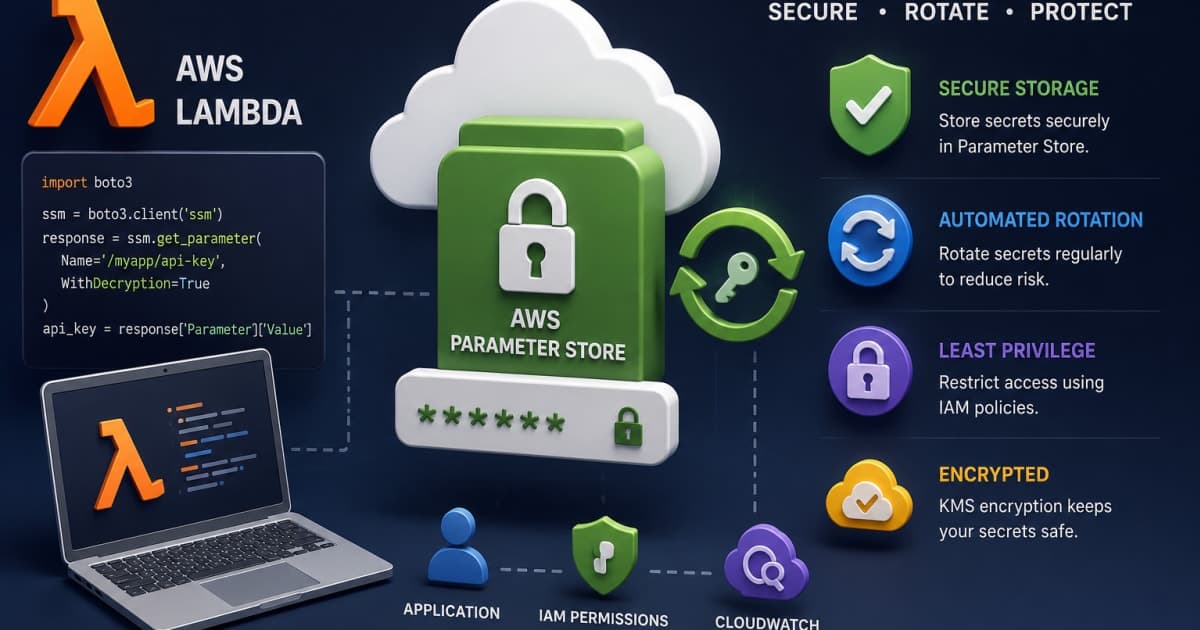
3. Secrets Management
Store API keys, database credentials, and other secrets in a secrets manager.
Grant secrets access only to the function’s IAM role.
Use environment variables that are encrypted at rest and decrypted at runtime.
4. Key Lifecycle Management
Automate key rotation and expiration.
Monitor for unused or orphaned keys.
Observability, Monitoring, and Anomaly Detection
Zero‑Trust relies on continuous observation to detect deviations from normal behavior.
1. Distributed Tracing
Implement tracing (e.g., OpenTelemetry) to follow requests across functions and external services. Correlate trace IDs with logs for quick root cause analysis.
2. Metrics Collection
Track:
Invocation counts
Execution duration
Error rates
Cold start frequency
Use these metrics to spot performance anomalies.
3. Log Aggregation
Centralize logs using a log management platform (e.g., ELK stack, CloudWatch Logs). Ensure logs are immutable and tamper‑proof.
4. Anomaly Detection
Statistical baselines for request rates and error patterns.
Machine learning models that flag unusual activity, such as sudden spikes in API usage from a new IP.
Compliance, Auditing, and Governance
Many industries mandate strict compliance frameworks (PCI‑DSS, HIPAA, GDPR). Serverless architectures can still meet these requirements.
1. Audit Trails
Maintain immutable audit logs that capture:
IAM role changes
Secret rotations
Configuration updates
2. Data Residency
Ensure that data is stored in compliant regions. Use regional endpoints for services like S3 and DynamoDB.
3. Encryption Key Separation
For highly regulated data, keep keys in a separate Hardware Security Module (HSM) or dedicated key store.
4. Policy Enforcement
Automate policy checks using tools like Open Policy Agent (OPA). Enforce rules such as “no function may write to public S3 buckets”.
Migration Checklist and Best‑Practice Recommendations
Moving an existing application to a serverless, Zero‑Trust architecture requires careful planning.
Step | Action |
|---|---|
Assessment | Inventory all functions, data stores, and external dependencies. |
Segmentation | Group functions into logical units (e.g., payment, user auth). |
IAM Hardening | Replace broad policies with fine‑grained roles. |
Gateway Configuration | Set up API gateway with authentication, rate limiting, and WAF. |
Secrets Migration | Move all secrets to a secrets manager; update functions to fetch at runtime. |
Encryption | Enable encryption at rest and in transit for all services. |
Observability Setup | Deploy tracing, metrics, and log aggregation. |
Compliance Review | Run automated compliance checks; fill audit logs. |
Pilot Deployment | Deploy a subset of functions; monitor for anomalies. |
Full Rollout | Gradually replace legacy components. |
Continuous Improvement | Review logs, update policies, and rotate keys regularly. |
Best‑Practice Tips
Use Infrastructure as Code (IaC) (e.g., Terraform, CloudFormation) to version all security configurations.
Adopt a “Security‑First” CI/CD pipeline that includes static code analysis, secrets scanning, and policy checks.
Perform regular penetration testing targeting the API gateway and function endpoints.
Educate developers on secure coding practices specific to serverless (e.g., avoid hard‑coded secrets).
Future Trends and Conclusion
Serverless is evolving rapidly. Emerging trends that will shape Zero‑Trust in this space include:
Edge‑based serverless: Functions running closer to users, reducing latency but expanding the attack surface.
AI‑driven threat detection: Leveraging machine learning to spot sophisticated anomalies in real time.
Composable security: Modular security components (e.g., policy engines, identity brokers) that can be plugged into any serverless stack.
Cross‑cloud Zero‑Trust: Unified security policies that span multiple cloud providers, essential for multi‑cloud strategies.
In conclusion, Zero‑Trust Architecture is not a buzzword but a necessary evolution for securing serverless environments. By meticulously applying least‑privilege IAM, hardening API gateways, encrypting data, and embedding continuous monitoring, organizations can protect their serverless workloads against modern threats. The migration path is systematic: assess, segment, harden, monitor, and iterate. With the right tools, policies, and practices, serverless can be both highly efficient and highly secure.
FAQs
Q1: Can I use the same IAM role for multiple serverless functions?
A1: While possible, it is highly recommended to assign a unique role per function. This limits the blast radius if one function is compromised.
Q2: How often should I rotate secrets in a serverless environment?
A2: Rotate secrets at least every 90 days or immediately after a security incident. Automated rotation pipelines simplify this process.
Q3: What is the best way to secure data at rest in DynamoDB?
A3: Enable server‑side encryption (SSE) with a customer‑managed key in KMS. Ensure that only authorized roles can decrypt the data.
Q4: Can I use JWT tokens for authentication at the API gateway?
A4: Yes. Validate